Humble
A tribute to Carl Sagan and to science.
November 6, 2017
(it happens to be Carl Sagan’s birthday today and I like to think he would approve of this post. Unless stated the quotes are from/by Carl Sagan)
Man in his arrogance thinks himself a great work, worthy the interposition of a deity. More humble & I believe truer to consider him created from animals. (Charles Darwin, Notebook C, 1838)
In 1752, Voltaire sent two enormous aliens to visit Earth. A philosopher greets them, looks them up and down, and explains to their faces that their persons, their worlds, their suns and their stars “were created solely for the use of man.” The two travellers fall against each other, “seized with a fit of inextinguishable laughter.”
There are two different things we could mean by humility. One is about knowledge: I might be wrong. The other is about status: not everything is about me. The arrogance I want to talk about is what happens when you combine them badly.
Uncertainty on its own is harmless. The trouble is that we don’t sit in it. When the evidence runs out we don’t suspend judgement — we reach for whichever answer flatters us. Given a gap, we fill it with ourselves. “Characteristically, willy-nilly, we seem compelled to project our own nature onto Nature.” We put ourselves at the centre of the solar system, at the top of creation, in charge of our own minds — not because anything showed us we were, but because nothing had yet shown us we weren’t, and it was nice there. Kant could still write that “without man the whole of creation would be a mere wilderness, a thing in vain, and have no final end.” Sagan’s verdict on that: self-indulgent folly.
“But our preferences do not determine what’s true.” Science doesn’t hand us the truth in exchange, either — it offers “not absolute truth, only asymptotic approaches to the truth — never there, just closer and closer.” What it does do, reliably, is take the flattering guesses off the table one at a time. Sagan called these corrections the Great Demotions: “downlifting experiences, demonstrations of our apparent insignificance, wounds that science has, in its search for Galileo’s facts, delivered to human pride.”
Wounds, and not everyone wants them. I can empathise: arrogance is an excellent painkiller, and I have helped myself to plenty of it — I still do, impulsively. But I would rather be told what is actually wrong with me than be kept comfortable. Here are the demotions I keep coming back to, roughly in the order they arrived.
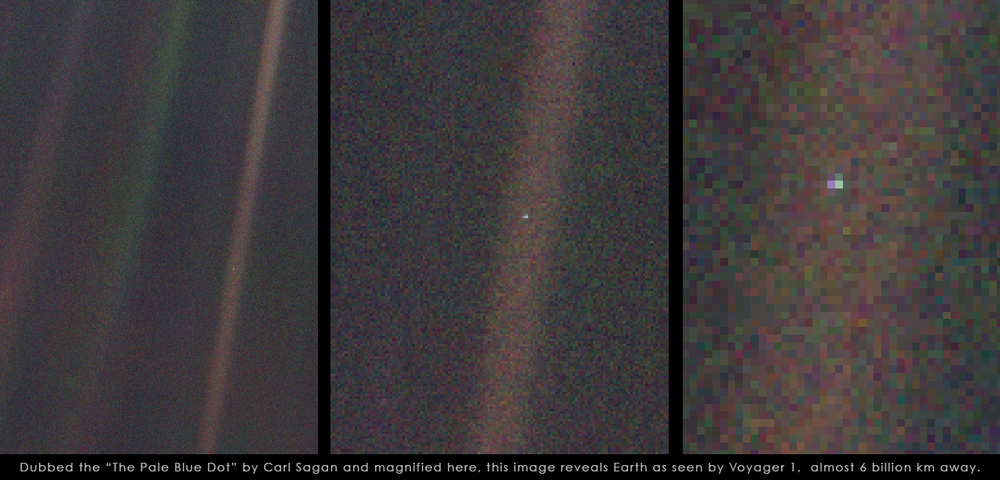
Astronomy taught us that we are not at the centre. Then that the Sun isn’t either, sitting as it does in “an undistinguished sector of an obscure spiral arm” thirty thousand light years out. Then that our galaxy is one of a hundred billion, “notable neither in mass nor in brightness nor in how its stars are configured.” We live “on an insignificant planet of a hum-drum star lost in a galaxy tucked away in some forgotten corner of a universe in which there are far more galaxies than people.” Each time we retreated to a smaller claim, and each time it went too. “We have not been given the lead in the cosmic drama.” See Pale Blue Dot.
Chemistry taught us that we are not made of special material. Living things were supposed to be built from something categorically different — until urea was synthesised from plain chemicals in 1828, and starlight, put through a prism, turned out to be running on our periodic table. “We are made of star-stuff”: the commonest elements there are, thrown out by dying stars, with nothing held in reserve for us.
Evolution taught us that we were not designed. Not made in the image of anything — assembled by a very long run of accidents, each kept only because it happened not to kill us. “We’re Johnny-come-latelies. We live in the cosmic boondocks. We emerged from microbes and muck. Apes are our cousins.”
Thermodynamics taught us that we don’t get to keep any of it. The universe is running down, and every ordered thing in it, us included, is a local eddy paid for by making a bigger mess elsewhere. Life doesn’t defy entropy; if anything, life is unusually good at hurrying it along. How the ending actually goes is still open — that depends on cosmology we don’t have yet — but “the universe is not required to be in perfect harmony with human ambition.”
Medicine taught us how confident we can be while doing harm. For two thousand years the best-educated people alive treated the sick by draining their blood. Doctors were affronted by the suggestion that they wash their hands. The lobotomy won a Nobel Prize in 1949. None of this was fringe — it was the consensus of the credentialed, which is why “there are no sacred truths; all assumptions must be critically examined; arguments from authority are worthless.” This is the demotion I find hardest to shrug off, because it comes with a body count.
Physics taught us that we are not omnipotent, and neither is anything we might appeal to. We cannot travel faster than light, however much we will it. If there’s no moisture in the air it will not rain, no matter how many cattle we sacrifice. The universe is not refusing us. Refusing would mean it had heard the request.
Logic and computation taught us that reason has edges — and reason is what found them. Gödel showed in 1931 that any system strong enough to do arithmetic contains true statements it cannot prove. Turing showed in 1936 that there are questions no procedure will ever answer. These aren’t gaps in our cleverness that a smarter species would close; they’re permanent. The humbling part is that the limit was proved from the inside.
Chaos taught us that knowing the rules is not the same as knowing what happens. We assumed that once we had the laws the future was just arithmetic — Laplace’s demon, give it the positions and it reads off the rest. Then it turned out that in most interesting systems the tiniest error in the input swamps the answer. Weather runs out at about two weeks. Determinism and predictability are not the same thing, and we only get one of them.
Psychology taught us that we are not the reasoners we take ourselves to be. Given a simple logical rule to test, most people check the case that would confirm it and skip the one that could refute it. Asked to rate ourselves against our peers — as drivers, as colleagues, as ethical people — the overwhelming majority of us land above average. And when the real cause of a choice is hidden from us, we don’t notice the hole; we produce a confident explanation anyway. What’s damning isn’t that we make mistakes. It’s that the mistakes have a direction. They lean, reliably, towards whatever we’d prefer to be true.
Behavioural genetics taught us that we didn’t write ourselves. Temperament, personality, most of what we’d call character: substantially heritable, and much of the remainder traceable to circumstances nobody chose. Two people, one raised in a neglectful home and one in a loving family, end up very different. The proportions are still argued over and the effect sizes are modest, but the direction isn’t in doubt. “Our thoughts and feelings are not fully under our own control.”
The microbiome taught us that we are not even one organism. You’re a consortium: roughly as many bacterial cells along for the ride as human ones, digesting your food and, it increasingly seems, having some say in your mood. The line around “you” was drawn for convenience, and it was drawn in the wrong place.
Artificial intelligence taught us less about machines than about where we keep hiding. Chess was going to be the test of ‘real’ thought, until Deep Blue. Then Go, too intuitive for a machine, until AlphaGo. Then language, until that fell too. Each time we lost, we quietly relocated the essence of thinking to whatever was still ours. That reflex is more revealing than any of the results.
Neuroscience taught us that the inner life is machinery — and that machinery can be reached. Run a current into the right patch of cortex and the patient laughs, then supplies a reason for laughing. A tumour in the wrong place can rewrite somebody’s morals, and removing it can hand them back. A drug given for Parkinson’s can install an appetite for gambling in a person who never gambled. Whatever it is in us that we were tempted to call a soul, it has a blood supply, and it can be switched off.
What demotions are still to come? Is our universe one of many? Is consciousness an illusion? Does other intelligent life exist?
And the one I can’t answer from here: what am I currently certain of for no better reason than that it suits me? Sagan had the right instinct about his own case. On the mediums who offered to put him in touch with his dead parents: “Because I want so terribly to believe that, I know I have to reach in for added reserves of skepticism.” The rule generalises, and it runs exactly opposite to instinct — “we demand the most rigorous standards of evidence especially on what is important to us.” The beliefs that need the hardest look are the ones I’d hate to lose.
Humility is why I like science. Not the findings — the findings get revised, and some of the ones above will be among them. What I like is that it is “more than a body of knowledge. It’s a way of thinking. A way of skeptically interrogating the universe with a fine understanding of human fallibility.” It’s the only way of thinking I know of that’s built to catch its own user in the act.
And it’s worth saying that the reassuring fables aren’t contemptible. They’re for something.
The trapdoor beneath our feet swings open. We find ourselves in bottomless free fall. If it takes a little myth and ritual to get us through a night that seems endless, who among us cannot sympathize and understand? […] Modern science has been a voyage into the unknown, with a lesson in humility waiting at every stop. Our common sense intuitions can be mistaken. Our preferences don’t count. We do not live in a privileged reference frame. If we crave some cosmic purpose, then let us find ourselves a worthy goal.
Comments