Chords are shapes
What an isomorphic keyboard makes visible about harmony
July 20, 2026
On a piano, C major and D major are played with different hand-shapes: a different mix of black and white keys, different fingering. That is an accident of the keyboard, not a fact about harmony. The twelve notes are symmetric — transposing a piece changes nothing about its structure — but the piano breaks the symmetry by colouring seven keys white and five black.
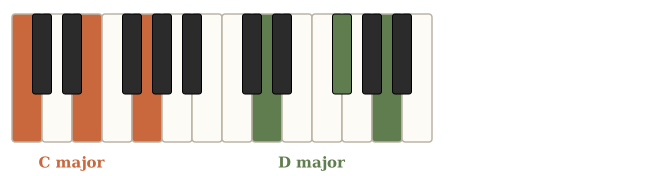
C major is three white keys; D major reaches up to a black one. Same chord type; nothing about the hand-shape survives.
An isomorphic layout keeps the symmetry: put the twelve notes on a hexagonal grid so that moving in a fixed direction always changes the pitch by a fixed interval. Transposition becomes translation. A chord stops being a fingering and becomes a shape — the same shape at every root.
The claim: on an isomorphic grid, a chord type is a translation-invariant shape, a scale is a straight line, a progression is a walk, and the major/minor duality is a half-turn. I built a playable hexboard — everything below is a picture of something you can press.
A chord is a shape
The layout in this post is the Wicki–Hayden grid: one step right raises the pitch a whole tone (+2 semitones), up-right a perfect fifth (+7), up-left a perfect fourth (+5). Those two directions generate the whole plane.
The position→pitch map is the same everywhere, so a chord’s shape does not depend on its root. A major triad is one three-hex figure:
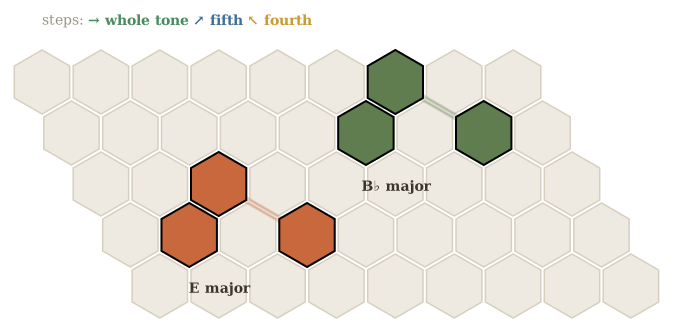
The same shape at two roots — E major and B♭ major are congruent. Learn one voicing, learn all twelve.
That is the pedagogical pitch of isomorphic instruments: you memorise shapes, not keys. A ii–V–I is one gesture, translated around the grid.
Two diagonals, one circle
The two “up” diagonals are the perfect fifth and the perfect fourth — the intervals harmony is built from.
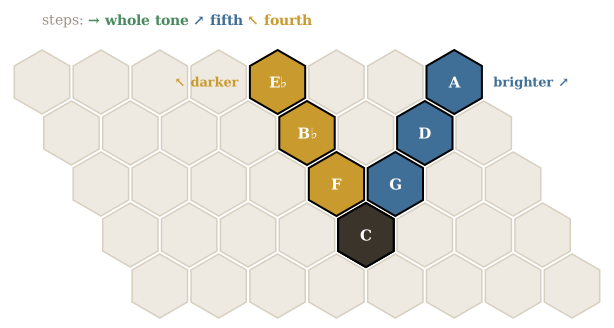
From any note, up-right stacks fifths (C→G→D→A…), up-left stacks fourths (C→F→B♭→E♭…).
The two diagonals are not independent ladders. A fourth is an inverted fifth — up a fourth (C→F) is the same note-name as down a fifth — so both diagonals walk the same sequence of twelve notes, in opposite directions. Twelve steps along either one visits every note once and comes home. The closed loop is the circle of fifths:
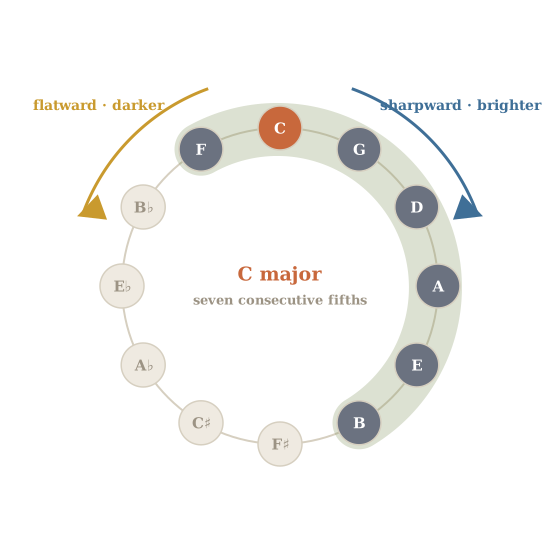
One loop, two directions: clockwise is the grid’s up-right diagonal, counter-clockwise the up-left. Each clockwise step adds one sharp to the key signature (G major has one, D major two, …) and each counter-clockwise step adds one flat — so I’ll call the two directions sharpward and flatward from here on. The fifths diagonal on the grid is just this circle unrolled into a straight line.
A major scale is seven consecutive notes on the circle of fifths — the highlighted arc. C major = F C G D A E B. And since the circle unrolls into the grid’s diagonal, a scale is a straight line:
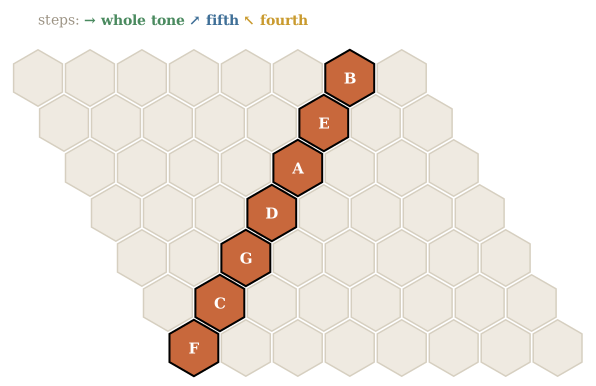
Seven notes, one line. The “gaps” between the white-key patterns on a piano are an artefact; the scale itself is perfectly regular.
Direction doesn’t matter: seven steps flatward from C (C F B♭ E♭ A♭ D♭ G♭) is also a major scale — D♭ major. Any seven-in-a-row works. Two separate questions are hiding here:
- Which seven notes? The position of the window on the circle. Sliding it sharpward or flatward changes key (C major → G major → …).
- Which note is home? The same seven notes F C G D A E B played with C as home are C major; with A as home, A minor; with D as home, D dorian. The tonic’s position inside the window picks the mode.
Brightness — Jacob Collier’s term for this — is the second question. Fix the tonic and slide the window sharpward one notch: Lydian, the brightest mode. Slide it flatward, notch by notch: Ionian → Mixolydian → Dorian → Aeolian → Phrygian → Locrian, one sharp — one notch of brightness — lost per slide. The brightness spectrum is the position of a rigid line on the lattice, relative to home.
(That is the relative minor: A minor as a re-rooting of C major’s line. The parallel minor — C major versus C minor — is a different relationship; it gets its own section below.)
The brightness axis also explains chord quality. A triad’s root and fifth form a spine; major and minor differ only in where the third sits:
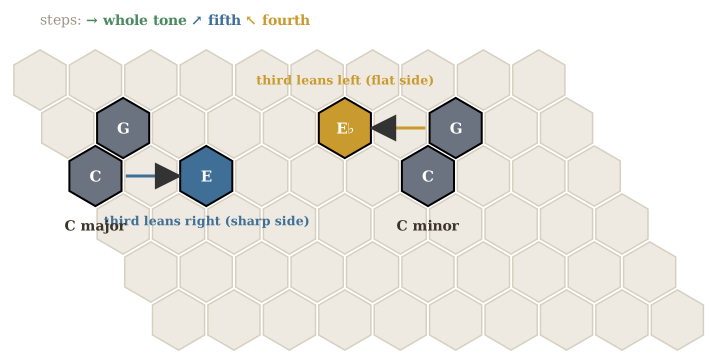
Same spine, two thirds. The major third (E) sits two steps to the right of the root; the minor third (E♭) two steps to the left of the fifth. And right/left here is the sharp/flat divide in disguise: one step right is a whole tone, which is two consecutive fifths (C→G→D), i.e. two clockwise notches round the circle — so rightward of the spine is the sharp side, leftward the flat side. A chord is major or minor according to which side its third leans; “bright chord” and “dark chord” are literal directions.
The pentatonic is a shorter line
If seven-in-a-row is a scale, what is five-in-a-row? Trim one note off each end of the C major line:
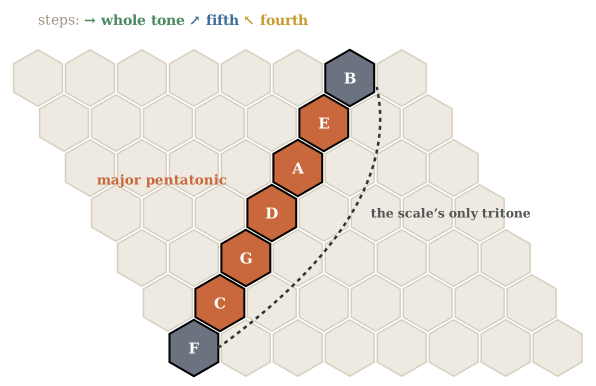
C G D A E — the major pentatonic. The trimmed pair, F and B, is the scale’s only tritone (six semitones — the octave’s dissonant halfway point). The pentatonic is the major scale minus its single harshest interval, which is why nothing in it clashes.
This is the geometry under “you can’t play a wrong note on the black keys”: the black keys are a pentatonic. The five notes left over when C major’s seven are removed — F♯ C♯ G♯ D♯ A♯ — are five-in-a-row further along the same line (G♭ major pentatonic). Remove a window; the complement is a window. Blues notes are the opposite move — notes far off the segment. “Outside” playing is literally outside.
Progressions walk the same line
The strongest root motion in tonal harmony is a fall of a fifth — on the grid, one step down the up-right axis. A progression built by chaining fifth-falls is a straight walk to the tonic:
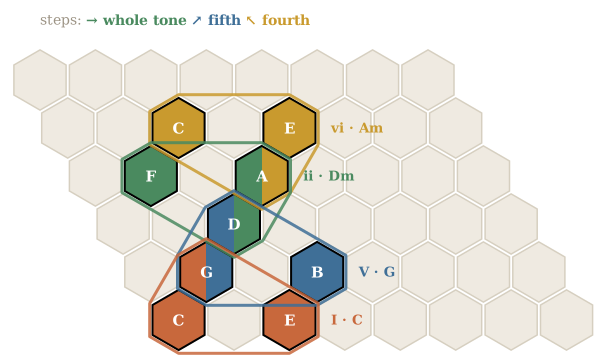
One colour per chord: Am (vi, gold) → Dm (ii, green) → G (V, blue) → C (I, terracotta), each root a perfect fifth below the last, arriving home on the tonic. The split-coloured hexes are the notes two neighbouring chords share — a common tone literally handed from one chord to the next as the walk descends.
Most named progressions in jazz and pop are pieces of this one walk:
- V–I (G → C) is the last step alone: the perfect cadence, the strongest single move in tonal music.
- ii–V–I (Dm7 → G7 → Cmaj7) is the last two steps — jazz’s default cadence, the cell most standards are stitched from.
- vi–ii–V–I (Am → Dm → G → C) adds one more and is the classic turnaround that loops the band back to the top of the form.
- Keep extending backwards and you get the full circle-of-fifths sequence: tunes like Autumn Leaves and Fly Me to the Moon run six or seven fifth-falls in a row — their whole chord chart is one long slide down this diagonal.
- A IV–V–I cadence is the same fifth-fall into I, approached by one whole-tone step (one hex to the right) from IV up to V.
The turnaround needs only two stamps: the minor-triad shape (vi, ii) and the major-triad shape (V, I), each pressing slid one notch down the line, overlapping the next on the shared note.
Classical theory calls “repeat a pattern, transposed by a fixed interval” a sequence; on this grid a sequence is rubber-stamping — one shape, one translation vector, pressed repeatedly. The strongest case is the chain of applied dominants (ragtime turnarounds, jazz cycles): each chord is the dominant of the next, so one dominant-seventh stamp marches down the fifths axis until it lands home:
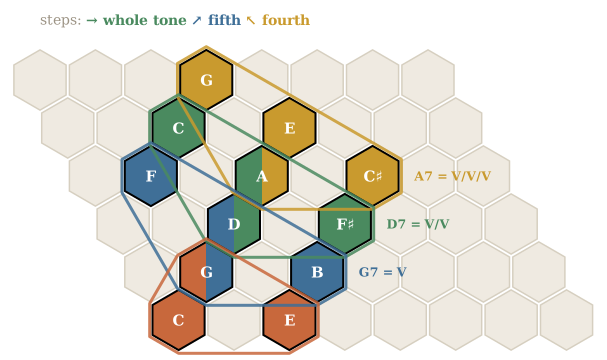
A7 (gold) → D7 (green) → G7 (blue) → C (terracotta): three pressings of the same four-note stamp, one step down-left each time. As before, the split-coloured hexes are the common tones each chord hands to the next. On a staff this is four different chords to spell; here it is one gesture, repeated.
Neighbouring keys are neighbouring lines
A key’s seven notes are a seven-fifths line; the next key round the circle is the same line slid one notch. So C major and G major overlap in six of their seven notes:
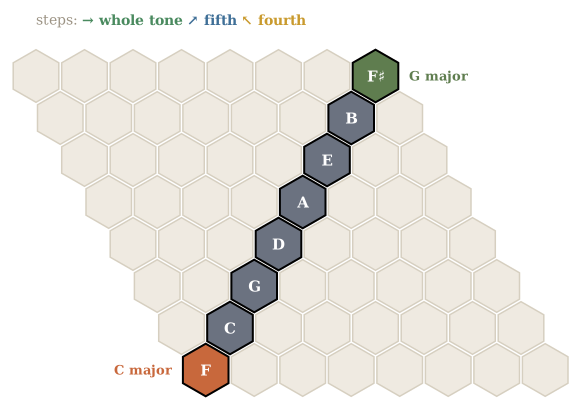
C major = F + the shared six; G major = the shared six + F♯. Modulating up a fifth is sliding the line by one. Keys a tritone apart are far-apart lines — which is exactly why they sound distant.
The arithmetic is exact: slide the window by k fifths and the two keys share 7−k notes, every k giving a different overlap. That perfectly graded family of distances is special to the diatonic scale (a deep scale, in the jargon) — most seven-note sets don’t measure key distance this cleanly.
Minor is major, turned upside down
If sharp/flat is a direction, what is major/minor? A half-turn.
This is the geometry of negative harmony (Ernst Levy’s idea, popularised by Collier). In pitch: flip each note to the note the same distance the other side of the point midway between tonic and dominant, $x \mapsto (\text{tonic} + \text{dominant}) - x = 7 - x$ for C. Tonic and fifth swap (C↔G); the major third folds onto the minor third (E↔E♭); C major becomes C minor.
One subtlety, which the grid makes honest. In one-dimensional pitch that flip is a reflection about a point. On the two-dimensional lattice it is not a mirror across a line: the swapped pairs (C–G, E–E♭, …) run in different directions, so no single line bisects them all. The map that realises it is a 180° rotation about a centre — the ⊕ below, between E♭ and E. “Flipping the chord upside down” is literal: a half-turn.
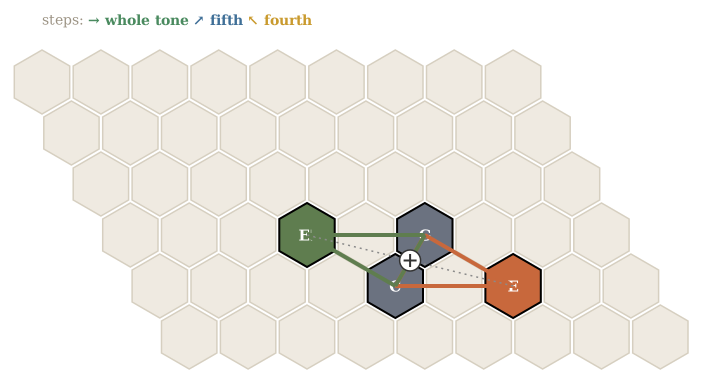
Every note sits diametrically opposite its partner through the ⊕ centre. C and G swap across the shared edge; E turns over to E♭. The result is C minor.
Because it is a rotation, it acts on any voicing — an inversion half-turns onto a re-voiced minor chord, about the same centre:
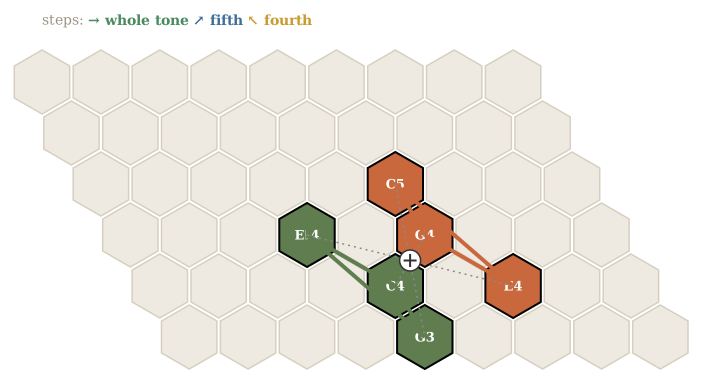
Same ⊕, different voicing: C major in first inversion (E4–G4–C5) half-turns onto a C-minor voicing (G3–C4–E♭4) — the highest note lands as the lowest.
Seventh chords sort into two classes under the half-turn. A major-seventh chord turns over into another major-seventh — Cmaj7 onto A♭maj7:
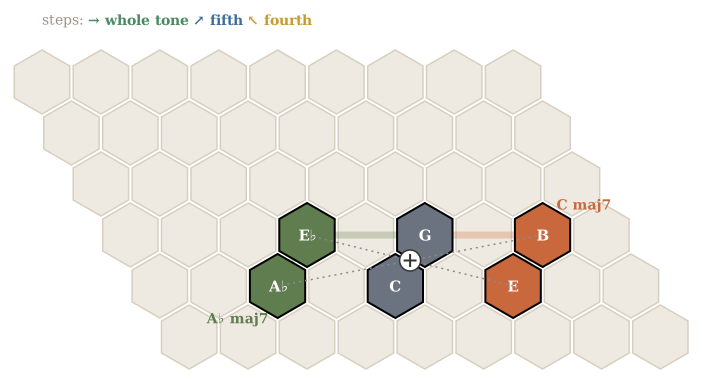
C maj7 (C E G B) and A♭ maj7 (A♭ C E♭ G) are point-reflections of each other, still sharing C and G. The chord type survives the flip because a maj7 is a palindrome of stacked thirds — major·minor·major reads the same upside down. (Minor sevenths are palindromes too: minor·major·minor. And it works from any root — B maj7 half-turns onto A maj7 the same way.)
A dominant seventh is not a palindrome — major·minor·minor upside down is minor·minor·major, a half-diminished chord. G7 turns over onto Dm7♭5:
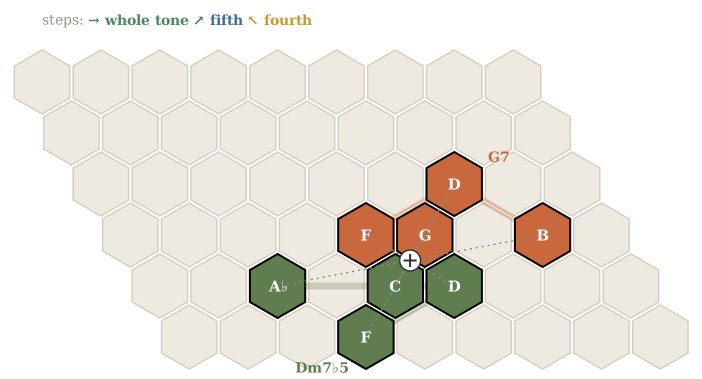
G7 (G B D F) half-turns onto Dm7♭5 (D F A♭ C) — no common notes, one shape upside down. Those two chords are the V and ii of a minor-key ii–V. The half-turn sends dominant function onto subdominant function — which is why negative harmony turns perfect cadences plagal. (The dominant-seventh/half-diminished pair is also the example of inversion-related chords in Tymoczko’s Science paper.)
Applied to a whole progression, the half-turn swaps dominant and subdominant function throughout. The atom, though, is the pictures above: the major/minor duality is one half-turn.
The tritone sub
A tritone is three whole tones — six semitones, exactly half the octave. C major contains exactly one: F–B, the pair the pentatonic trimmed away. It is the engine inside a dominant chord: G7’s third and seventh are B and F, each a semitone from a note of the tonic triad — B below C (the leading tone, pulling up), F above E (pulling down). Resolve both and the tritone collapses onto C and E. That squeeze is why V7 resolves to I.
Because the tritone is half the octave, two dominant chords a tritone apart contain the same tritone: D♭7 spells D♭–F–A♭–C♭, and C♭ is B — so G7 and D♭7 share exactly the pair (B, F) that does the pulling. Either resolves to C. That is the jazz tritone substitution, and on the grid it is two roots hanging off one shared edge:
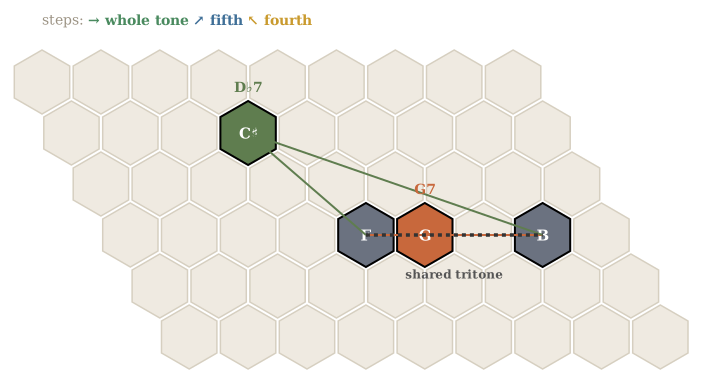
G and D♭ sit a tritone apart, but both reach the same B–F tritone. Swap one dominant for the other and the guide tones do not move — only the bass drops a semitone.
Go press some hexes
Everything above lives on a single layout, Wicki–Hayden, where the two “up” diagonals are the fifth and the fourth. But which intervals you assign to the directions is a free choice, and a different choice exposes different structure.
Have a go yourself. The hexboard lets you switch layouts, slide a chord shape around, and hear that it really is the same chord everywhere.
Comments