Ballot Structure from the Preference-Dependency Graph
Which questions should a ballot ask together? The votes can tell us.
July 17, 2026
A ballot is a design. It fixes which issues are decided together, which separately, and what each question may be contingent on. Yet nearly every voting system picks one of two extremes without asking: direct democracy decides every issue on its own; party or platform voting bundles everything into a few take-it-or-leave-it packages.
Each extreme is the right design for exactly one kind of electorate. If preferences are independent across issues, issue-by-issue voting is perfect — and cheapest. But once issues are coupled (“I want the carbon tax only if the revenue is rebated”), deciding them separately can elect a package a majority dislikes. Bundling everything avoids that, but scales badly: a bundle over $m$ issues has $2^m$ combinations, so real ballots offer a short menu of them, and every preferred combination left off the menu goes unexpressed.
I’ve just published v2 of a paper (and an open-source pipeline) that treats the ballot as an object to be designed from the electorate’s preference structure — estimated from nothing more than Polis-style agree/disagree votes.
A ballot fixes which issues are decided together, which separately, and what each question may be contingent on — and almost every voting system picks one of two extremes. Direct democracy asks every issue alone: optimal when preferences are independent across issues, but able to elect a package a majority dislikes once they are coupled (the multiple-election paradox). Platform voting bundles everything into a few take-it-or-leave-it packages: faithful to any structure, but forced to offer a short menu of the $2^m$ combinations, leaving preferred combinations unexpressed. We treat the ballot as an object to be designed from the electorate’s preference structure. A ballot, in general, is a rooted forest of contingent questions — “if the tax passes, should the rebate follow?” — with the familiar designs as its contingency-free special cases. Any ballot forgoes welfare in exactly two ways — separability-distortion, from deciding coupled issues in separate questions, and menu-distortion, from offering fewer combinations than voters demand — and both are governed by the dependency graph of voter preferences. Losses come only from couplings the questions fail to cover: they vanish entirely under coverage and, on today’s partition ballots, are bounded by the severed coupling mass. Contingent questions decide chain- and tree-structured coupling exactly at cost linear in the number of issues — the cost of a faithful ballot is exponential only in the graph’s treewidth, not in the size of its coupled blocks. Because the graph is latent, we estimate it from Polis-style agree/disagree votes and read the ballot off the estimate, provably exactly when the structure is clean. We show who pays when a budget forces a cut, and how ballots are attacked (duplicate-flooding the agenda; menu riders) and repaired. The pipeline is validated on synthetic electorates and real Polis conversations — including vTaiwan’s Uber deliberation, where the ballot recovered from votes alone matches, in outline, the agenda Taiwan ratified in 2016.
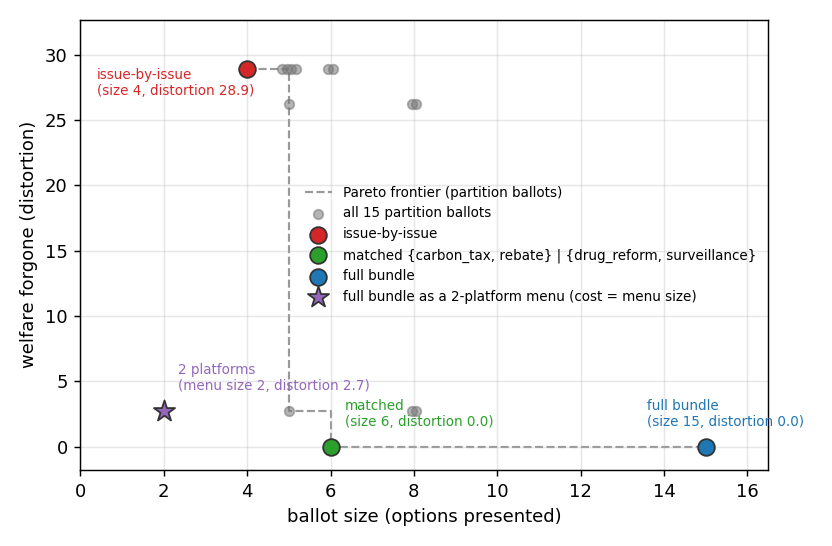
The whole design space of a four-issue example: welfare forgone against ballot size, one point per ballot. The frontier steps down as each extra question “buys” one more respected coupling — issue-by-issue severs everything and pays the most; the ballot matched to the preference-dependency graph reaches zero at a fraction of the full bundle’s size.
Links
- Paper (v2): zenodo.org/records/21409990
- Code: github.com/act65/ballot-structure — every figure and number in the paper is reproducible from it
- All versions: doi.org/10.5281/zenodo.20819571
Comments, counterexamples, and pointers to related work are very welcome.
@misc{telfar_2026_21409990,
  author       = {Telfar, Alexander},
  title        = {Ballot Structure from the Preference-Dependency Graph},
  month        = jul,
  year         = 2026,
  publisher    = {Zenodo},
  version      = {v2},
  doi          = {10.5281/zenodo.21409990},
  url          = {https://doi.org/10.5281/zenodo.21409990},
}
Comments